Beyond Anxiety

Book of Wisdom: Beyond Anxiety by Martha Beck “Anxiety can’t just be ended. It must be replaced…To live with joy and optimism instead of constant worry, we don’t just need to subtract our troubles; we need to use our brains differently,” said Martha Beck
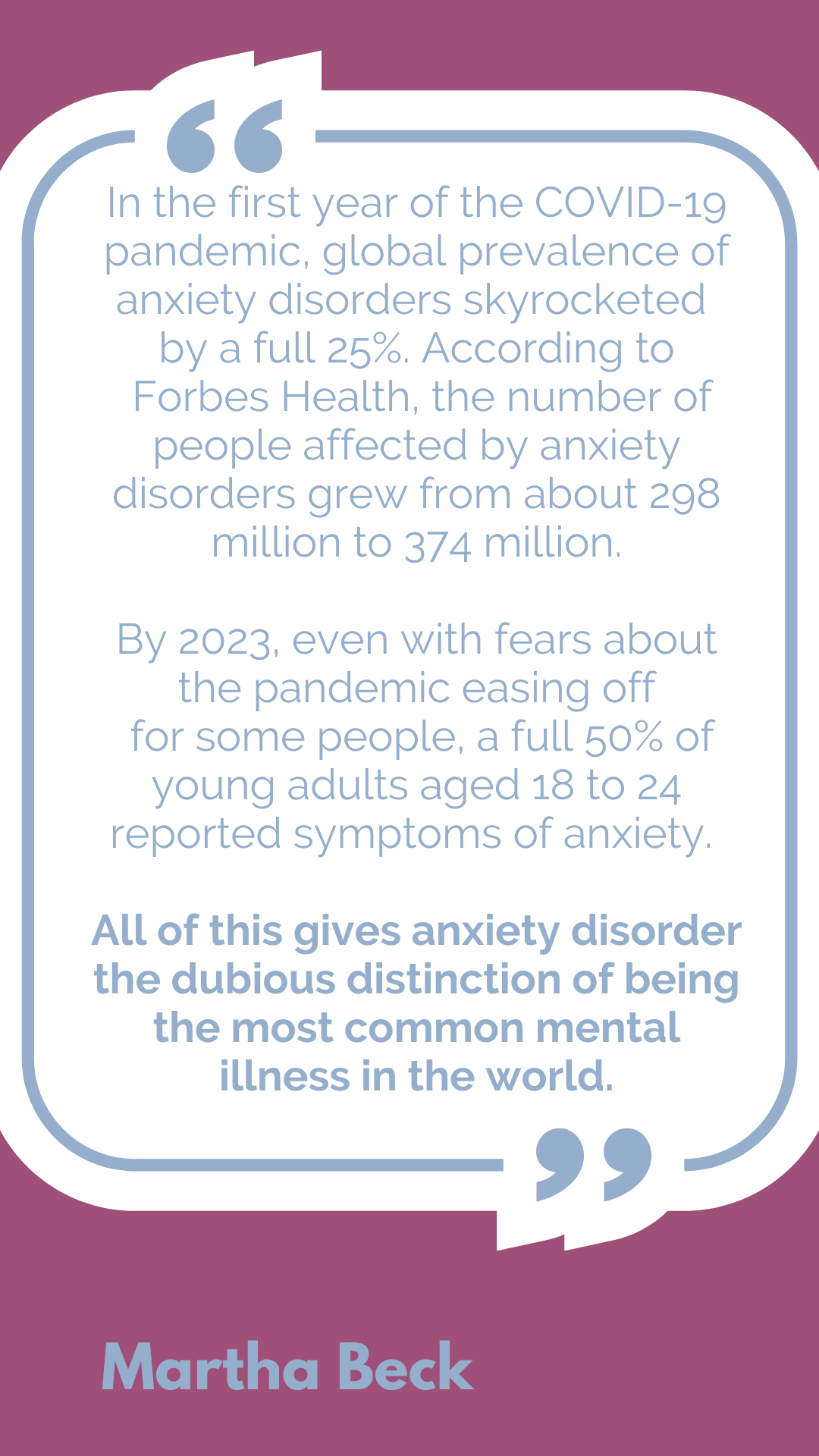
According to Martha Beck, "In the first year of the COVID-19 pandemic, global prevalence of anxiety disorders skyrocketed by a full 25%. According to Forbes Health, the number of people affected by anxiety disorders grew from about 298 million to 374 million. By 2023, even with fears about the pandemic easing off for some people, a full 50% of young adults aged 18 to 24 reported symptoms of anxiety. All of this gives anxiety disorder the dubious distinction of being the most common mental illness in the world."
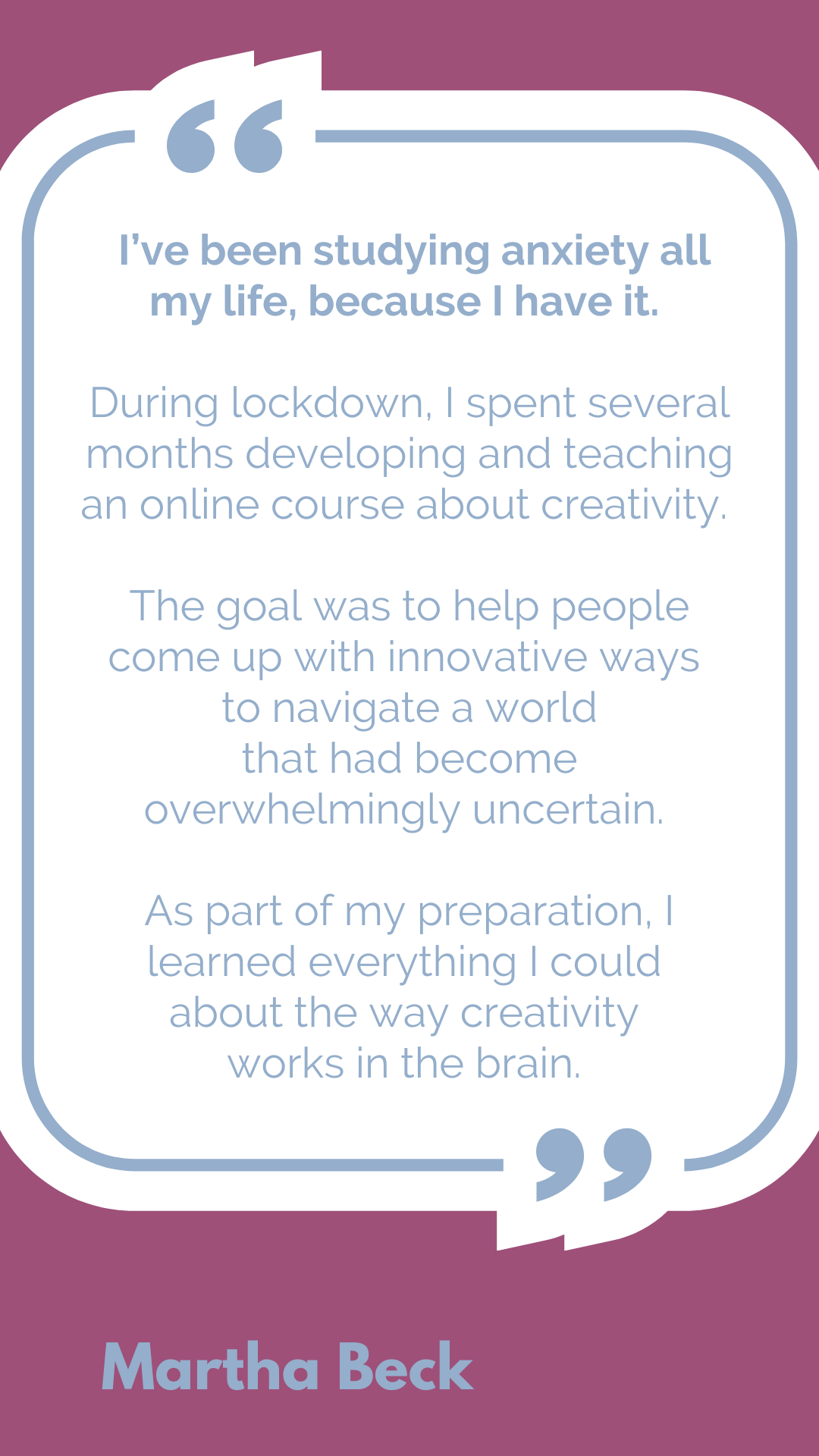
"I’ve been studying anxiety all my life, because I have it. During lockdown, I spent several months developing and teaching an online course about creativity. The goal was to help people come up with innovative ways to navigate a world that had become overwhelmingly uncertain. As part of my preparation, I learned everything I could about the way creativity works in the brain," said Martha Beck.
"I became fascinated with the neurological dynamics of anxiety—how it works in our brains and also in our behaviors and social interactions. I was particularly intrigued by the evidence that shows a kind of toggle effect between anxiety and creativity: when one is up and running, the other seems to go silent. I began to play with something I called “the art of calm,” because it was all about using creativity to calm my anxiety," said Martha Beck.
"We’re all taught to unconsciously activate an “anxiety spiral” in our brains…From early childhood, you have been constantly rewarded for thinking in a certain way: verbally, analytically, in organized lines of logic. The part of your brain that you’re strengthening is located largely in your left hemisphere… inside everyone’s buffed-up left hemisphere is a neurological mechanism I call the 'anxiety spiral,'" said Martha Beck.
"Anxiety is contagious. Even if we learn techniques that bring down our personal anxiety, engaging with a culture that’s full of anxiety can put us right back into the dread zone…The mirror cells in our brains shift to automatically reflect whatever the people around us are feeling. Images of danger and horror are being communicated more rapidly and universally, so we constantly hear and see reports of terrible things happening all over the world," said Martha Beck.
"Anxiety can’t just be ended. It must be replaced…To live with joy and optimism instead of constant worry, we don’t just need to subtract our troubles; we need to use our brains differently. We need practices that guide our thinking into new habitual pathways, new modes of perceiving and relating to the world. To stop doing this, we can shift our neural activity to a different set of brain structures and functions—the ones that generate curiosity, wonder, connection, compassion, and awe," said Martha Beck.
"I’ve read many, many books and articles about how to overcome anxiety, but they all stopped at the point of achieving calm. To me, this is like bailing out a sinking boat without plugging the leaks: a good first step but not the best long-term solution—and a sad place to stop when we’re within easy reach of a much, much more joyful way of life. Just dispelling anxiety means constantly bailing, working against the pull of our brain’s negativity bias and the pressures of our anxious society. Moving further into the right hemisphere means sailing off on thrilling adventures," said Martha Beck.
"When people tell me that their goal is to be free from anxiety, or that they long for a sense of purpose, they rarely realize that these objectives are two sides of the same coin…Living in a left hemisphere–dominated, overwhelmingly materialistic culture not only breeds anxiety but also shuts out the right hemisphere’s ability to perceive context, connection, and beauty. As this happens, we lose our sense of meaning," said Martha Beck.
"The strategies I’ll teach you in this book won’t merely make you a less anxious person; they’ll turn you into an artist of calm, a creative genius…You’ll learn about how to handle your biological and psychological tendency to get anxious… You’ll begin utilizing parts of your brain that pull you out of anxiety and into curiosity, fascination, and inventiveness...It will get easier and easier to calm the frightened creature in your brain and liberate your creative side," said Martha Beck.
The Things Your Mom Should Have Told You Book of Wisdom "Beyond Anxiety" by Martha Beck. “Where anxiety makes us avoid more and more of the world, curiosity draws us forward, helping us to get used to unexplored environments and unfamiliar experiences. Anxiety retracts; curiosity expands,” said Martha Beck.
“We’re living in a culture that’s heavily biased toward a very specific kind of thinking and behaving—the way preferred by the left hemisphere…Because the left hemisphere is also the part of the brain that gets stuck in anxiety spirals, this makes us sitting ducks for anxiety…The way our culture goes about trying to reduce anxiety also tends to be very left-brain dominated…We attack anxiety, fighting it like warriors on a search-and-destroy mission. This, as we’ll see, ends up making us more anxious, not less,” said Martha Beck.
“Anxiety is contagious. Every time we interact with other people, we run a high risk of getting caught up in their anxiety spirals, which will accentuate our own…Modern culture is like a massive anxiety spiral in which countless clever brains busily spin out terrifying stories and control strategies 24/7. Our ability to instantly communicate with huge numbers of people allows us to spread the misery faster and farther than ever before,” said Martha Beck.
“In fact, in our culture, anxiety is encouraged as a means of boosting productivity ever higher. Despite piles of evidence showing that we are most creative and ingenious when we’re calm, we often tell ourselves (and one another) that fear is the great motivator, a necessary component of high achievement. To stay productive, we believe, we should stay anxious,” said Martha Beck.
“This is why Amazon’s founder, Jeff Bezos, one of the wealthiest human beings in history, wrote to his stockholders, “I constantly remind our employees to be afraid, to wake up every morning terrified.” Living in fear, he asserts, is the way to stay ahead. This philosophy has certainly helped Bezos acquire his staggeringly huge fortune. But is it really “normal” for over a million Amazon employees to be terrified from the moment they wake up every day so that some of the richest people in the world can get even richer?” said Martha Beck.
“Because anxiety shuts down all curiosity about other people, it’s also toxic to relationships. It not only makes us judge each other harshly one-on-one but also feeds into sweeping judgments about people or groups of people. Anxiety reinforces prejudice and makes us suspect evil motives behind the most innocent actions. It can lead us to embody the very attitudes we don’t want to see in the world,” said Martha Beck.
“Responding to unfamiliarity with fear, we create anxiety spirals that narrow our minds until virtually no one fits into our zone of acceptance. We also adopt any implicit biases that reflect our culture’s overall discrimination against these “others,” even if we truly value justice and equity,” said Martha Beck.
“The only way we ever get used to something unfamiliar is by asking about it, exploring it, seeing it from different angles. And when the “unfamiliar thing” is a person, getting curious about that person’s experience cuts through anxiety and leads to connection,” said Martha Beck.
“There’s a better way to deal with anxiety, one that moves us away from our left hemisphere–dominated cultural models and allows our inherent wisdom to guide us into a more brain-balanced way of being,” said Martha Beck.
“Curiosity, the sensation that begins the creativity spiral, is the force that tempts many young animals, including humans, to experiment with new experiences. Where anxiety makes us avoid more and more of the world, curiosity draws us forward, helping us to get used to unexplored environments and unfamiliar experiences. Anxiety retracts; curiosity expands,” said Martha Beck.
“Creativity spirals…make us focus on the here and now, where we’re able to evaluate situations and either take useful action or simply feel safe. They also impel us to learn about different perspectives and make us want to express ourselves to others. That’s love in action. Once we feel grounded in safety and connection, the brain automatically asks, What can I learn? This makes us more inventive and intelligent,” said Martha Beck.
“Wondering is among the right brain’s favorite states of being, as are perceiving the present moment and noticing things about other people’s outer and inner lives. When we were very young, wondering was one of our predominant pastimes, practically our lifestyle. Once we learn how to calm our anxiety creatures and begin moving our attention into the curiosity of our right hemispheres, we can get that childlike wonder back. For keeps,” said Martha Beck.
“Once you begin turning on your interest curiosity, opening the secret doorway between worry and wonder over and over, you’ll find that the door starts to work more smoothly... Instead of living in anxiety and then digging around for curiosity, you may notice pulses of inquisitiveness popping up on their own, often displacing anxiety. Then curiosity may begin to eclipse anxiety entirely…All of this leads to a different way of engaging with the world,” said Martha Beck.
Things Your Mom Should Have Told You, Book of Wisdom: “Beyond Anxiety: Curiosity, Creativity, and Finding Your Life’s Purpose” by Martha Beck