The Search

The Things Your Mom Should Have Told You Book of the Month is "The Search: Finding Meaningful Work in a Post-Career World" by Bruce Feiler
Front cover of the book "The Search: Finding Meaningful Work in a Post-Career World" by Bruce Feiler


“Fewer people search merely for work these days. More people search for work with meaning. We’re moving from a means-based economy to a meaning-based economy. For generations, Americans have been fed a narrow definition of success. That script was passed down by our parents, encouraged by our neighbors, reinforced by our culture. These days, more of us are turning our backs on that playbook. We’re questioning its values and challenging its assumptions,” according to Bruce Feiler.
“Each of us is grappling with our own internal definition of success. We have a roiling assortment of homilies, parables, truisms, and beliefs, some imprinted on us by our families and inscribed on us by our surroundings, but more chosen by us from our role models and forged by us from our wounds. The best way to understand these stories is as a kind of scripture, a sacred treasure that each of us tries to live up to even as we try to break free from it,” said Bruce Feiler.
”This book is about learning to identify that scripture. Tapping into it at the defining moments in your life so that you don’t waste your time chasing someone else’s dream. You chase your own dream. That leads to the final step on this journey: taking control of your own work narrative,” said Bruce Feiler.
“In these pages, I explore the idea that each of us has what I call a work story, an ongoing, unspoken narrative that we’re constantly revisiting and revising in response to changes in our jobs, our families, and our lives…We need a new way to talk about work–one that doesn’t generalize our experience but individualizes it,” according to Bruce Feiler.
“The premise is simple: The biggest impediment to a meaningful life is not what you don’t know about work; it’s what you don’t know about yourself. Specifically, it’s understanding the underlying themes of your life. You can bounce from job to job; you can shift from field to field; but if you don’t tap into the earliest tensions, frustrations, and longings of your life – that personal scripture that’s unique only to you – you’ll never be happy,” said Bruce Feiler.
“We face a never-ending barrage of interruptions–some voluntary, other involuntary; some unique to us, others shared by the entire planet; some that grow out of changes in our workplace, others that grow out of changes in our mindsets. I call these moments workquakes… The people who get the most out of their biggest workquakes do three things: they immerse, they reflect, and they ascend. They excavate the past, they probe the present, and they construct the future,” according to Bruce Feiler.
Panel 7: “I call these three acts, collectively, a meaning audit. When done effectively, a meaning audit is the single biggest gift you can give yourself…To get the meaning you want, you first must identify the meaning you’re wanting…The essence of personal archaeology is using the tools of emotional excavation to resurface the underlying themes that have long directed your life,” said Bruce Feiler.
“We have 3 building blocks of identity, three levers we tug and push throughout our lives to maintain our sense of balance, purpose, and joy. I call these 3 elements the ABCs of Meaning. The A is agency–what we do, make, or create, our sense of autonomy, freedom, and mastery. For many of us, our sense of agency comes from our work. In narrative terms, our A is our me story,” said Bruce Feiler.
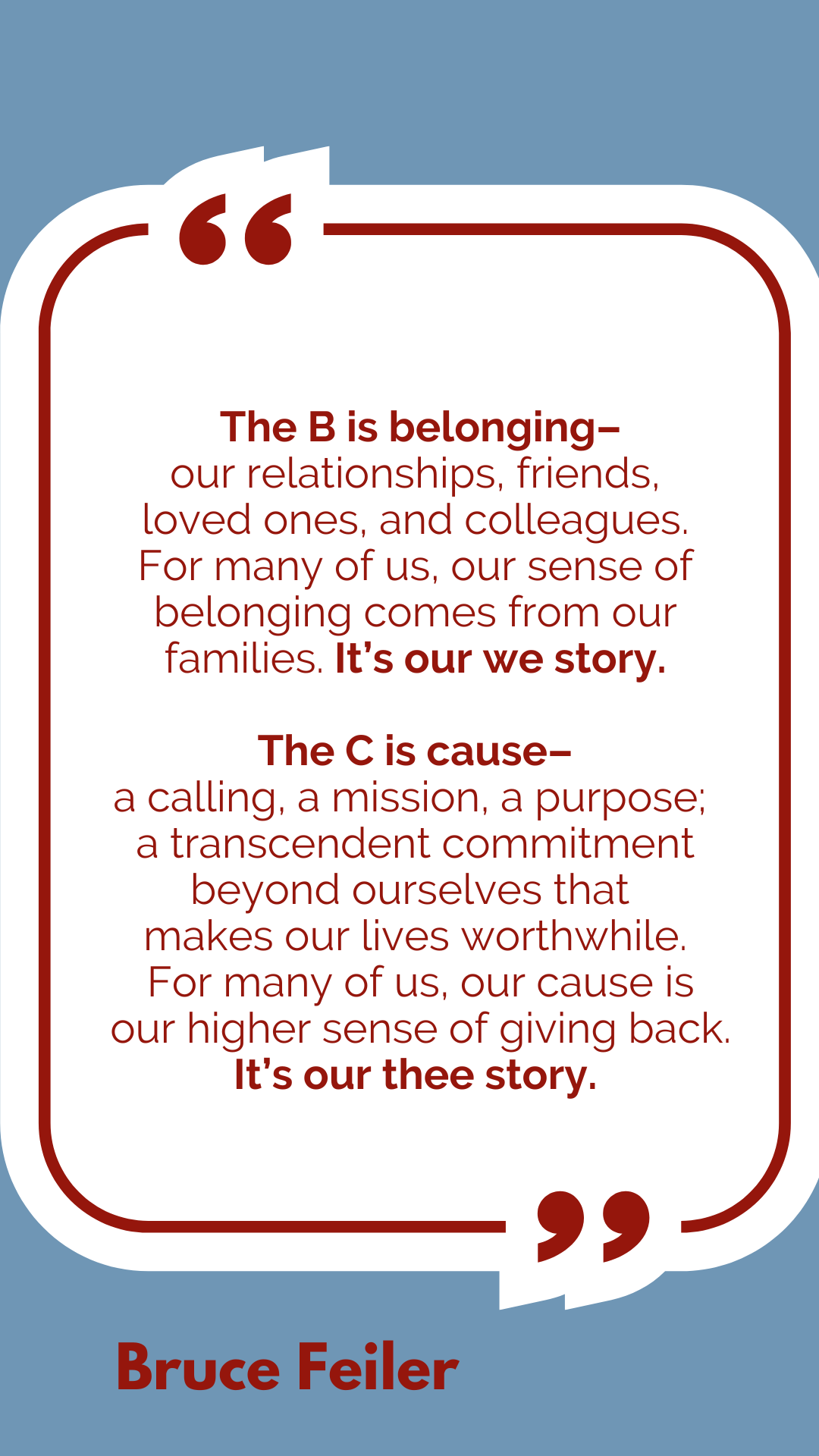
“The B is belonging–our relationships, friends, loved ones, and colleagues. For many of us, our sense of belonging comes from our families. It’s our we story.  The C is cause–a calling, a mission, a purpose; a transcendent commitment beyond ourselves that makes our lives worthwhile. For many of us, our cause is our higher sense of giving back. It’s our thee story,” said Bruce Feiler.
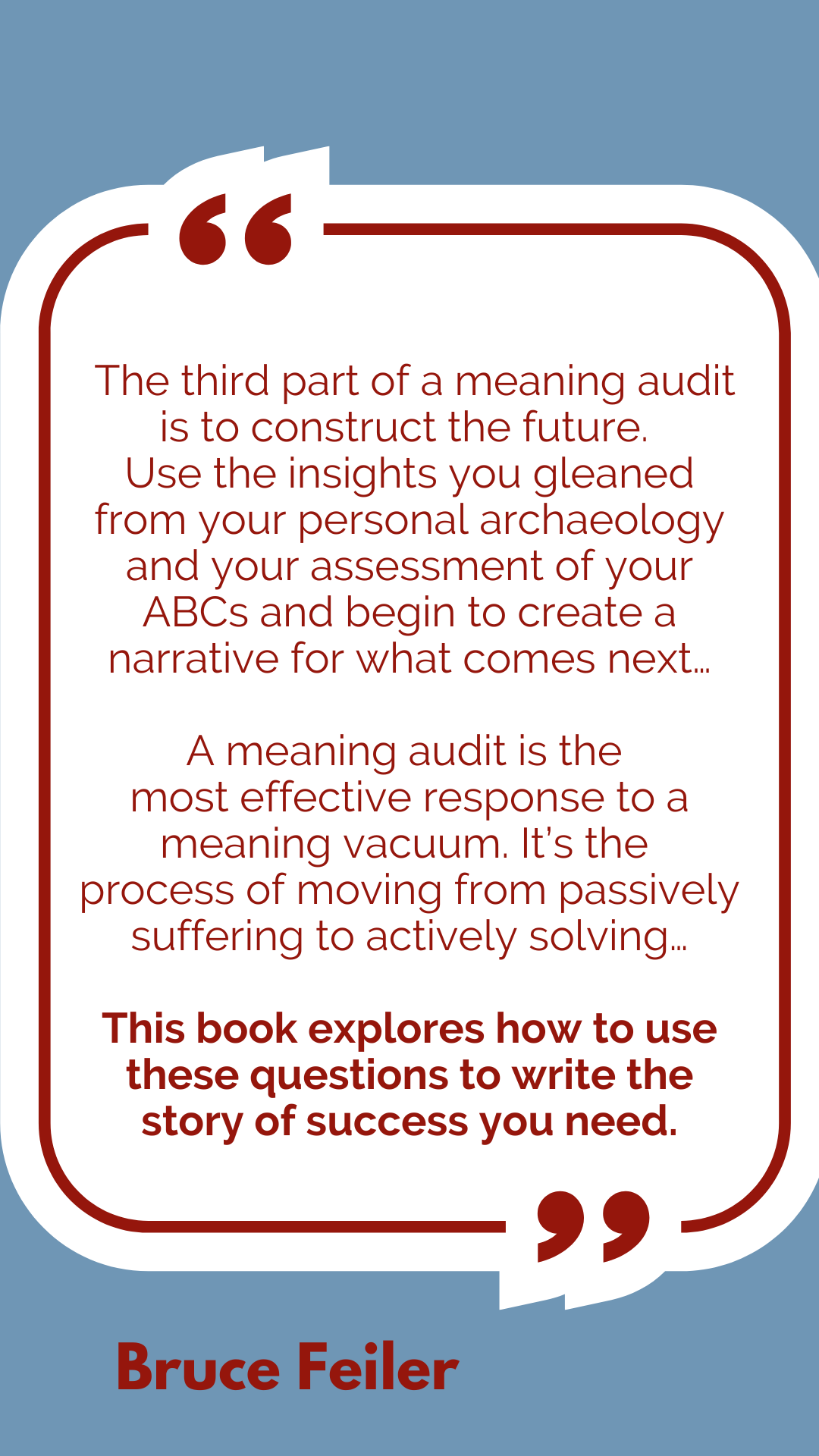
“The third part of a meaning audit is to construct the future. Use the insights you gleaned from your personal archaeology and your assessment of your ABCs and begin to create a narrative for what comes next…A meaning audit is the most effective response to a meaning vacuum. It’s the process of moving from passively suffering to actively solving…This book explores how to use these questions to write the story of success you need,” said Bruce Feiler.

“There is no universal story anymore. With no single job that will make you happy, you are free to accept whatever job you want. With no single path that will lead to your dreams, you are free to follow whatever dream you wish. With no single career that will define you forever, you are free to create your own uncareer,” said Bruce Feiler.
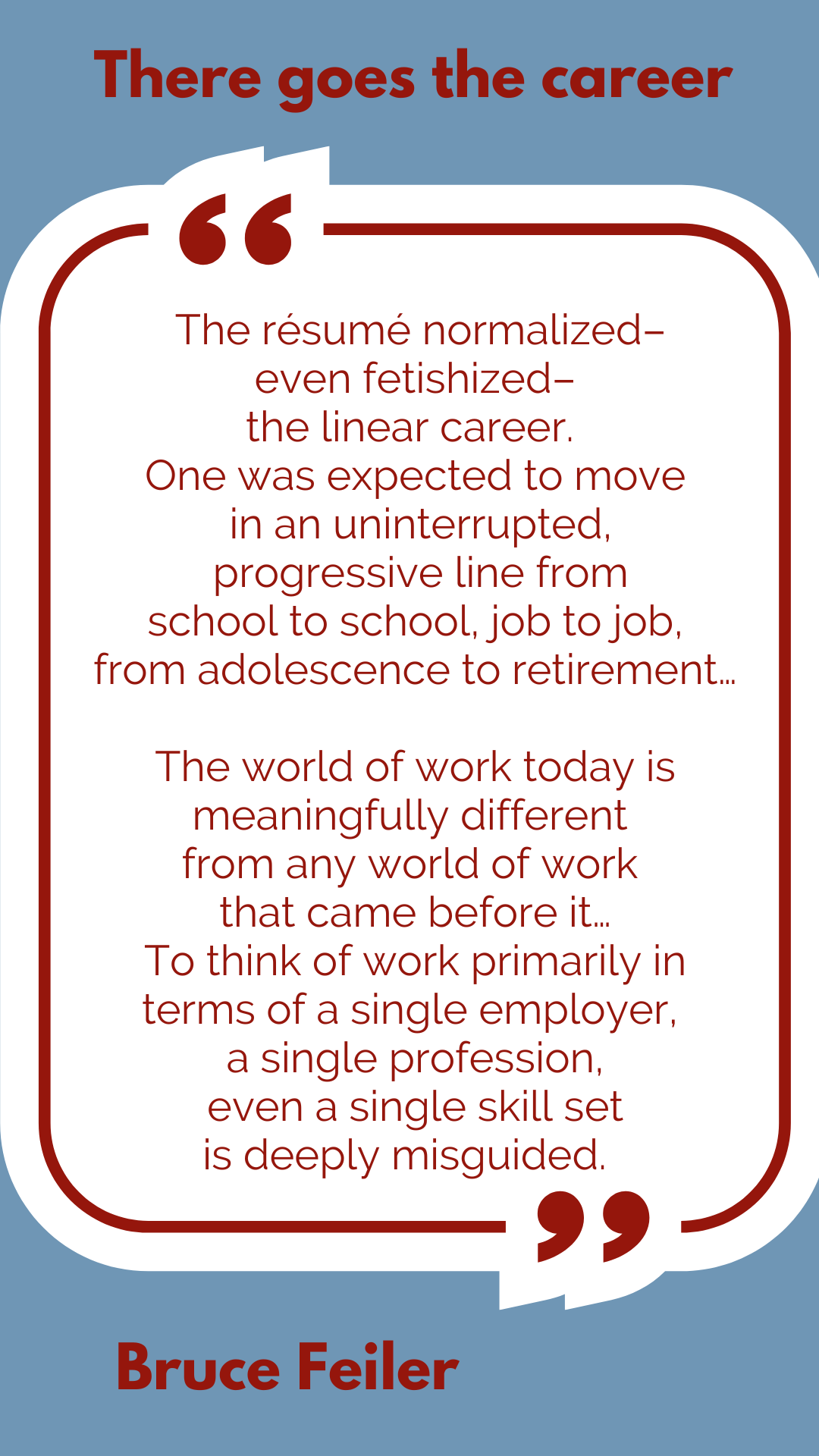
There goes the career “The résumé normalized–even fetishized–the linear career. One was expected to move in an uninterrupted, progressive line from school to school, job to job, from adolescence to retirement…  The world of work today is meaningfully different from any world of work that came before it…To think of work primarily in terms of a single employer, a single profession, even a single skill set is deeply misguided,” according to Bruce Feiler.
Words and tools haven’t kept up “As the pace of life has quickened, the pace of work has quickened. And yet during similar inflection points in history, when the numbers around work changed, the words around work changed, too–as did the tools for how to find work. But that hasn’t happened this time.   We’re still using outdated words and outdated tools. Neither the old-fashioned résumé nor its online facsimiles have kept up…Even the word career itself has lost value–it suggests we’re all pursuing a shared dream,” said Bruce Feiler.
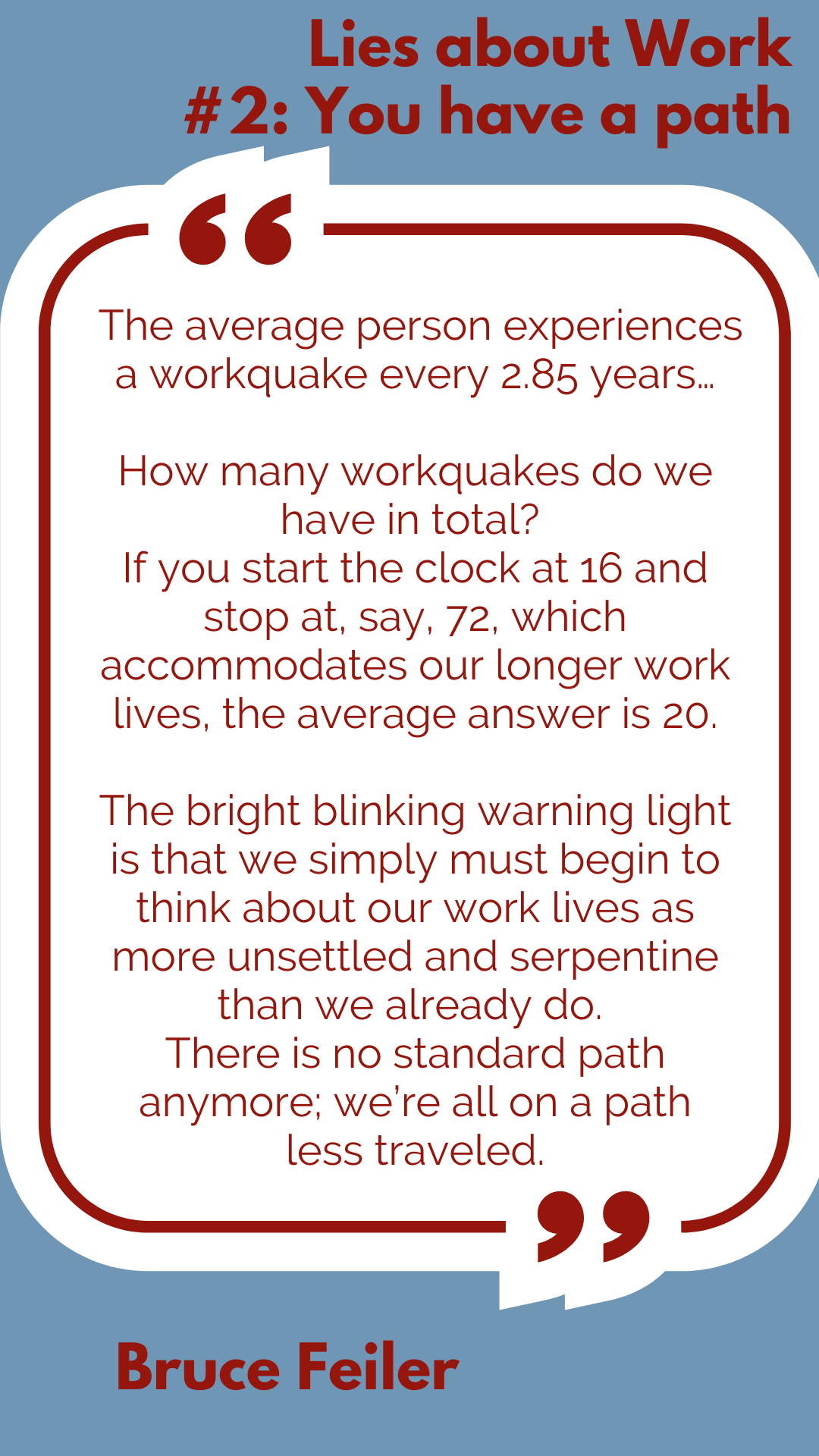
Lies about Work #2: You have a path “The average person experiences a workquake every 2.85 years…How many workquakes do we have in total? If you start the clock at 16 and stop at, say, 72, which accommodates our longer work lives, the average answer is 20.  The bright blinking warning light is that we simply must begin to think about our work lives as more unsettled and serpentine than we already do. There is no standard path anymore; we’re all on a path less traveled,” said Bruce Feiler.
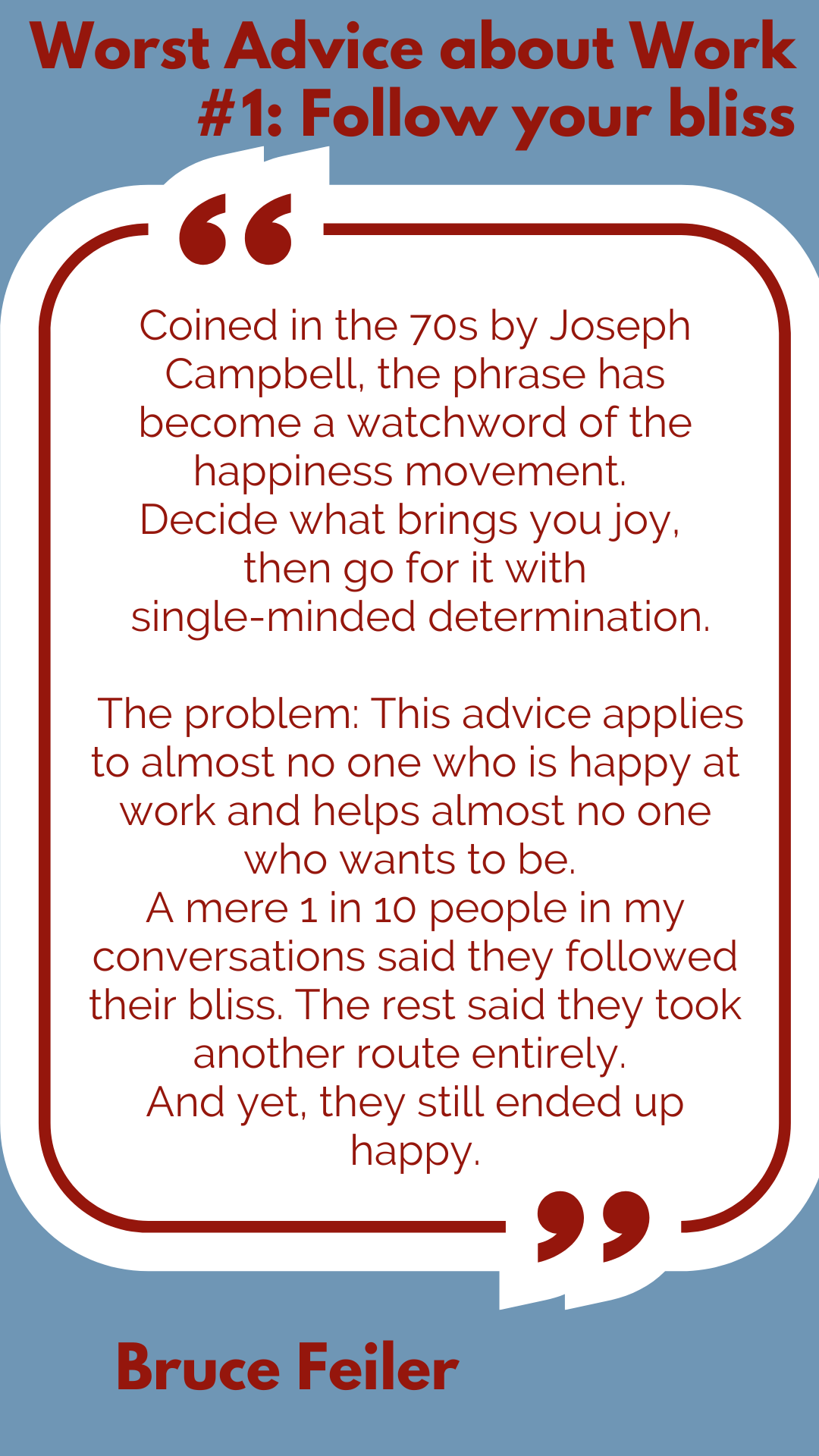
Worst Advice about Work #1: Follow your bliss “Coined in the 70s by Joseph Campbell, the phrase has become a watchword of the happiness movement. Decide what brings you joy, then go for it with single-minded determination. The problem: This advice applies to almost no one who is happy at work and helps almost no one who wants to be. A mere 1 in 10 people in my conversations said they followed their bliss. The rest said they took another route entirely. And yet, they still ended up happy,” said Bruce Feiler.
Worst Advice about Work #3: Keep your personal life out of your work life  According to Bruce Feiler, “The happiest people do the reverse: they understand that their lives are inseparable from their work…  A stirring conclusion of the Work Story Project is that the single biggest influence in our decisions about work–from what jobs we seek to what jobs we accept to what jobs we quit–is our life outside of work…    The very idea of separating life from work is a legacy of a time when the workplace was dominated by white men and someone else took care of the laundry, the kids, and the aging parents.”
Worst Advice about Work #4: Always keep your eye on the bottom line According to Bruce Feiler, “The last piece of legacy bad advice from the linear age is that the primary benchmark for measuring success is money…   Two researchers in Toronto, Jing Hu and Jacob Hirsh, found that if workers consider a job meaningful, they’re willing to accept salaries that are 32% lower than for unmeaningful work. A separate study by bestselling author Shawn Achor and colleagues found that 9 out of 10 employees were willing to give up a quarter of their entire life earnings in exchange for work that’s meaningful.”
The New Rules of Success #3: Success is not means; Success is meaning According to Bruce Feiler, “For too long, success was calculated almost entirely by numbers. The more money you made, the more successful you were. Today, a rival interpretation has taken hold. Success is a function of words. It’s about the meaning you assign to success. And each person gets to decide the meaning for themselves…   Money is no longer the only metric by which meaning is calculated. For an equally large number of people, meaning is found through service, creativity, self-expression, or giving back…Success is not means; success is meaning.”
Write your own damned story “The lesson of the Work Story Project is that there is power in the upright choice. There is pride in the unseized compromise. There is beauty in the unaccepted trade-off. Every search for meaningful work seems to contain at least one such uncustomary twist…  The glory in these stories is that our unnormal choices are becoming so common that they’re fast becoming the norm…  We are forging new rules for success in America. Write your own damned story. If not you, who? If not now, when?” said Bruce Feiler.
The Things Your Mom Should Have Told You Book of the Month: The Search: Finding Meaningful Work in a Post-Career World by Bruce Feiler