


According to a recent survey by the Match Group, 80% of Gen Z singles believe they’ll find true love, and 86% want to find a committed romantic relationship.
This doesn’t mean that dating is without its challenges.
Hinge, the company behind the dating app designed to be deleted, recently released its D.A.T.E. Report, an annual study that relies on a survey of 30,000 daters to identify and understand dating habits. You can read the 54-page report for yourself.
But I’d like to highlight three key findings that might improve the odds of finding the deep connection that 84% of Gen Z daters say they’re looking for.
Tip #1: Don’t avoid meaningful conversations
Many factors contribute to the tension between Gen Z and their potential romantic partners these days, but according to Hinge, the primary factor at the heart of it all is The Communication Gap–the disconnect between the deeper connection daters want and their willingness to initiate it.
Hinge found that Gen Z daters are 36% more hesitant than Millennials to initiate a deep conversation on the first date.
What keeps people from having a deeper conversation?
35% of Hinge daters say they’re holding back because they don’t know how to start one
43% of Gen Z women wait for the other person to initiate deep conversations because they assume men don’t want to have them
48% of Gen Z men hold back from emotional intimacy because they don’t want to seem “too much”
Hinge notes that the first generation to grow up on social media often has a sense of being watched, often leading Gen Z to self-censor and worry about how they’re perceived. As a result, Gen Z daters are 29% more likely to wait for the other person to initiate conversations than Millennial daters.
The problem is that connection doesn’t happen when everyone’s waiting; it happens when both people decide to give it a try.
You may assume you know what the other person wants, but be mistaken.
For instance, even though 43% of Gen Z women believe the people they date don’t want to have deep conversations on the first few dates, 71% of Gen Z men say they would like to have more meaningful chats.
So, in other words, if you take a chance on having a deeper conversation on a date, the odds are better than 2-to-1 that it will be well-received.
Moe Ari Brown, the love and connection expert at Hinge, notes: “When there’s a disconnect between how we think we should act and communicate, and how we actually want to act and communicate, it can lead to really unfulfilling dates. Dates feel stronger when both people try and contribute in the ways they actually crave.”
Tip #2 Don’t resist being emotionally open
The Hinge survey showed that Gen Z daters are more likely than Millennial daters to report fears around emotional intimacy.
Barriers to building emotional connection
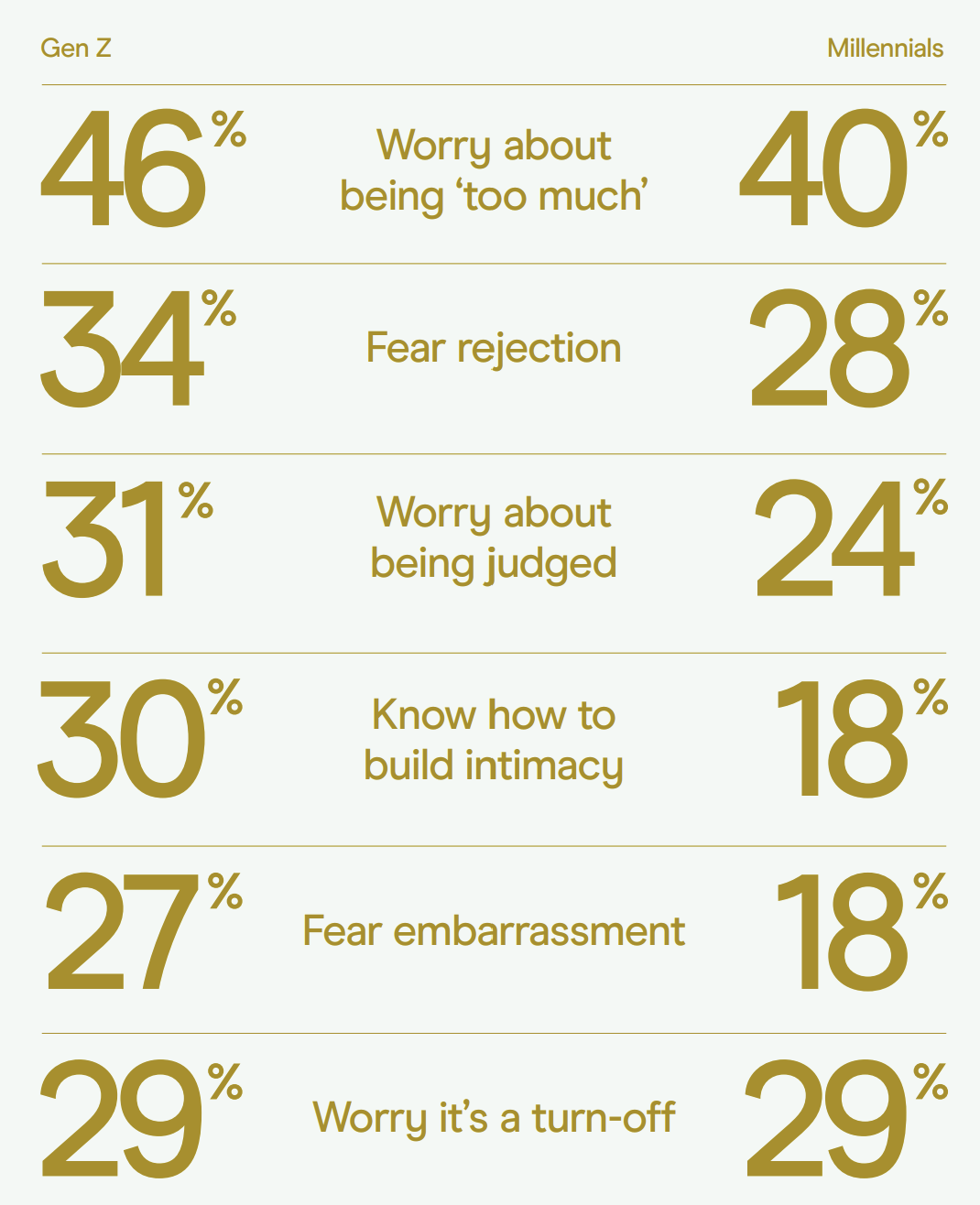
Since fears of emotional intimacy are so common, it’s not surprising that the survey revealed that 47% of Gen Z men have held back from asking deep questions out of fear of coming off as “cringe.” About 39% of Gen Z women say they have held back for fear of seeming “cringe” too.
Logan Ury, lead relationship scientist at Hinge, says the number one reason people hold themselves back is the fear of coming across as “too much.” And yet there’s a very real danger to self-censoring:
“We become our own worst critics, imagining judgment that’s usually harsher than what anyone else would actually think. The fear of being ‘too much’ makes us hold back so much that we end up doing nothing at all. Here’s the thing: when you’re constantly worried about seeming desperate or cringe, you’re already living in that rejection you’re trying to avoid. You’re just doing it to yourself first.
“The people worth knowing aren’t looking for someone perfect. They want someone who’s real. And real includes wanting things badly, caring deeply, and showing up fully even when it feels scary.”
Hinge’s Brown encourages daters to push past invisible scripts: “When there’s a disconnect between how we think we should act and communicate, and how we actually want to act and communicate, it can also lead to us feeling unfulfilled and inauthentic to ourselves.”
The reality is that most people have a fairly good chance of being on a date with someone who’s open to a deeper connection. The survey data show that 74% of Gen Z men and 70% of Gen Z women say they feel comfortable being emotionally open on the first date.
Tip #3: Ask your date enough questions
The experts at Hinge have identified a key problem that holds many daters back: the “Question Deficit.”
While six in ten daters believe they ask enough questions on a first date, only three in ten daters feel they’re asked enough questions.
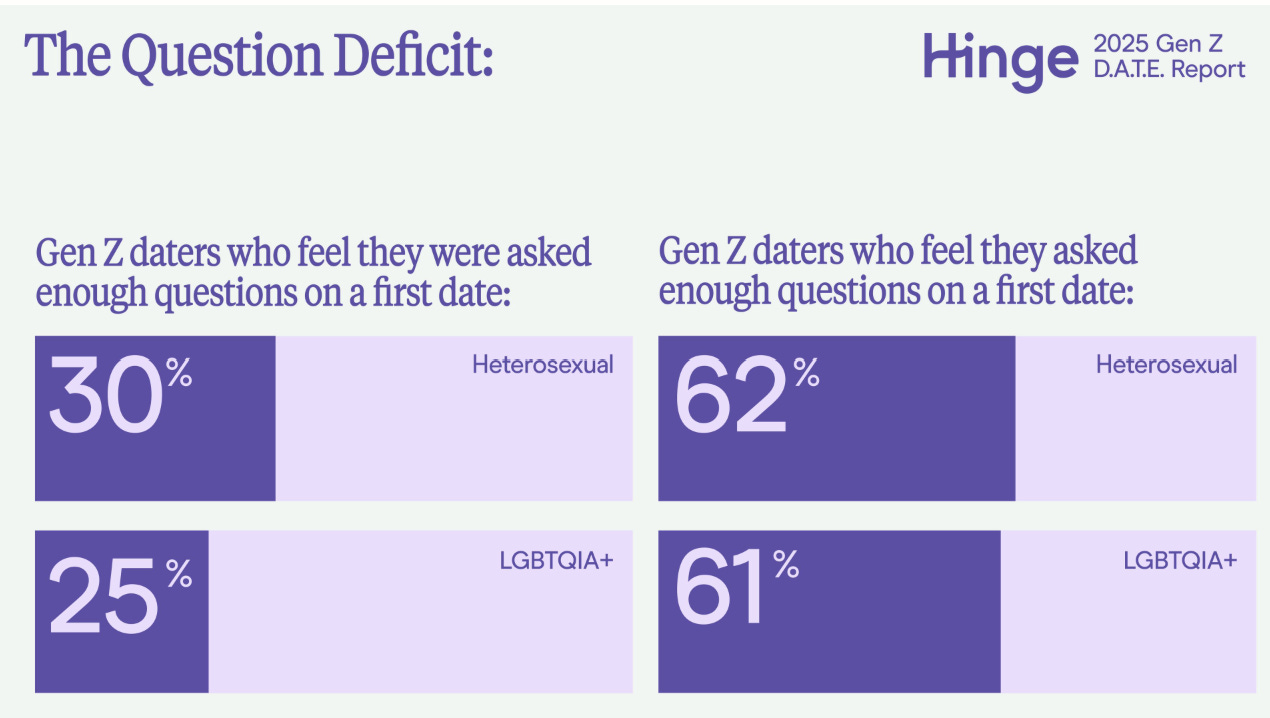
The Question Deficit leads many daters to believe they’re showing more interest than they actually do on a date. And this deficit is a problem–85% of daters are more likely to want a second date if they are asked thoughtful questions.
According to Hinge’s Ury, “Too many people walk away from dates saying: ‘He didn’t ask me a single question’ or ‘I could’ve written her biography, but she doesn’t know a thing about me.’ Questions are the foundation of intimacy—so don’t be a ZQ.”
To avoid the ‘zero questions’ date, Ury suggests:
Answer, then Reflect Back. If your date asks you something, answer—and then ask them the same. Don’t assume their silence means they’d rather listen. Even a simple “How about you?” keeps the conversation reciprocal.
Listen to Understand. Real listening isn’t just waiting for your turn to speak. Focus on what they’re saying, not your reply. Curiosity makes your date feel valued and helps both of you connect.
Hinge’s Brown offered some ideas for keeping the curiosity going in text conversations:
“A meaningful question invites a story, a reflection, and something more than yes/no. Instead of ‘wyd?’, a meaningful question might be: ‘What’s been the highlight of your day so far?’ or ‘What’s exciting you and lighting you up right now?’”
Ury sums up the big takeaway from the Hinge D.A.T.E. report:
“Gen Z has grown up in a world that often rewards playing it safe, but meaningful connection requires the opposite. The research is clear: the very things we’re afraid will make us ‘too much’ are actually what create the intimacy we’re craving.
“Whether it’s asking that follow-up question, sending a thoughtful Voice Note, or simply showing up as your authentic self on a first date, small acts of emotional bravery compound into deeper relationships.”
BTW, Logan Ury’s book, How to Not Die Alone, is a Things Your Mom Should Have Told You Book of Wisdom. Sample its content here.